This is pretty technical information, but worth digesting. There is more, much more.
Peter
from: http://nov55.com/ntyg.html
CO2 Absorption
There is no Valid Mechanism for CO2 Creating Global Warming
Proof one: Laboratory measurements show that carbon dioxide absorbs to extinction at its main peak in 10 meters under atmospheric conditions.* This means there is no radiation left at those frequencies after 10 meters. If then humans double their 3% input of CO2 into the atmosphere, the distance of absorption reduces to 9.7m. A reduction in distance is not an increase in temperature. Convectional currents stir the heat around removing any relevance for distance.
Scientists who promote the global warming hype try to work around this fact by claiming something different happens higher in the atmosphere, which they claim involves unsaturation. The difference due to height is that the absorption peaks get smaller and sharper, so they separate from each other. Near the earth's surface, the absorption peaks for water vapor partially overlap the absorption peaks for CO2. Supposedly, in some obfuscated way, separating the peaks creates global warming. There is no real logic to that claim. It is nothing but an attempt to salvage global warming propaganda through obfuscation of complexities.
What it means is that climatologists admit there is no mechanism at lower levels of the atmosphere, and their rationalization for higher up is phony.
It's important to realize that radiation from the sun does not greatly heat the atmosphere, because the sun must give off high frequency radiation in the area of visible light, which goes through the atmosphere. Something as hot as the sun cannot give off low frequency radiation, called infrared. This means that the sun's radiation heats the surface of the earth, and then the heat moves from the earth's surface into the atmosphere through conduction, convection, evaporation and infrared radiation. The infrared radiation can be absorbed by so-called greenhouse gasses.
The Absorption Peaks
Carbon dioxide absorbs infrared radiation (IR) in three narrow bands of frequencies, which are 2.7, 4.3 and 15 micrometers (µM). This means that most of the heat producing radiation escapes it. About 8% of the available black body radiation is picked up by these "fingerprint" frequencies of CO2.
Heinz Hug* showed that carbon dioxide in the air absorbs to extinction at its 15µM peak in about ten meters. This means that CO2 does whatever it's going to do in that amount of space. Twice as much CO2 would do the same thing in about 5m. There's no significant difference between 5m and 10m for global warming, because convectional currents mix the air in such short distances.
But humans could not double the CO2, because they only put 3% of the CO2 in the air. If they put twice as much in, it would do whatever it does in 9.7m instead of 10m. If humans stopped putting any CO2 in the air, it would do whatever it does in 10.3m instead of 10m. In other words, nothing humans do with CO2 could be of the slightest relevance to global warming, even if oceans were not regulating it.
(The weaker peaks and shoulders of the peaks absorb in longer distances. While strongest absorption occurs in 10m, weaker absorption for CO2 occurs in about 300 meters. But a 3% increase in CO2 is still only a 3% reduction in the 300m distance for the weak absorption areas.)
The Attempted Fix
This is nothing new. Climate scientists know that more CO2 does not result in more heat under usual conditions. So the mythologists among them try to salvage the global warming propaganda by pretending that something esoteric occurs higher in the atmosphere. The difference is that the absorption peaks for CO2 separate from the peaks for water vapor. Then supposedly, radiation which misses CO2 does not get picked up by water vapor and travels into outer space; and more CO2 causes less radiation to get missed on the shoulders of the peaks.
Everything about that rationalization stretches reality to a point of misrepresentation. The increase in CO2 levels could only be relevant for the last cycle of absorption near the outer edges of the atmosphere, where there is not enough influence of the lower atmosphere to be significant. But the rationalizers claim it is significant in the mid levels of atmosphere. Not so. A 3% increase in CO2 would only shorten the distance of radiation travel by 3% before total absorption occurs.
In other words, at mid levels of the atmosphere, the center of the peaks would absorb at about 30m instead of 10m, while the shoulders would absorb at about 1,000m instead of 300m. Reducing those distance by 3% is not relevant. But just like relativity, if it takes more than a mouthful of arguing to prove them wrong, frauds decree the obfuscation to be fact.
As shown on the page titled "Crunching the Numbers," the quantities involved are so miniscule as to be totally incapable of causing global warming.
There's another major reason why the fix is unreal. Supposedly, it is the outer shoulders on the CO2 peaks which are responsible for global warming. Not only is a small percent of the CO2 influenced by the shoulder radiation, but the distance increases for absorption. There is more nitrogen and oxygen per CO2 molecule in this area. Dilution reduces the temperature increase per unit of energy. If there is 5% as much CO2 on the shoulders, it is spread over 20 times as much space in the atmosphere. This means the temperature effect on the shoulders should be multiplied times 5% twice—once for the decrease in amount of CO2 and once for the dilution of the energy in the atmosphere. So much dilution of so few molecules could not be responsible for a significant amount of temperature increase.
The miniscule area of concern on the shoulders of the absorption peak for CO2 is shown on one of Heinz Hug's graphs, linked below.
The Ill-Informed Assumptions
The assumption of some persons is that shorter distances mean the heat stays in the atmosphere longer before escaping into space. Supposedly, the radiation will be re-emitted and re-absorbed more often, when distances are shorter. But they err in two ways. One is in not taking into account the convection which removes the relevance of short distances. The other is in assuming the direction is toward space.
When radiation is re-emitted in the atmosphere, it moves in all directions. The energy does not move closer to space, because it is not directional. The only way heat can move toward the outer atmosphere is through convectional currents.
Here's how the dynamic works. The IR is emitted from the surface of the earth as black body radiation, which has a wide bandwidth. Then CO2 absorbs a fingerprint set of frequencies, which is 8% of the available black body radiation. As it is absorbed, it is instantly converted into heat (in less than a pico second). The heat is distributed over all molecules in the atmosphere, which means 78% nitrogen and 21% oxygen. After some time (probably about 10 hours), an equivalent amount of black body radiation is emitted from everything in the atmosphere, and 8% of it is absorbed by CO2 as fingerprint radiation.
Proponents do not have clear explanations for their assumptions. They use computer models and juggle the numbers until they get the results they want.
Adendum:
The fingerprint type of IR absorption is due to stretching and bending of internal bonds. Nitrogen does not do that. But all matter absorbs and emits IR in proportion to its temperature. This is called "black body" radiation. Physicists say all matter has the same characteristics in absorbing and emitting black body radiation, except that the quantitative proportions vary, mostly due to reflection. For nonreflective substances, such as wood and concrete, the percent IR absorbed or emitted (called emissivity or absorptivity) is around 90% of a perfect black body. Metals are good reflectors of IR, so they have an emissivity of around 50%. This means they emit or absorb about 50% of the infrared radiation which contacts them. Kirchhoff's law says emissivity equals absorptivity, which means everything absorbs and emits black body radiation in the same way.
There is a curve for black body radiation, and it applies to all matter. The curve slides toward higher frequencies for higher temperatures. At earth temperatures (around 300 degrees Kelvin) the black body curve (or Planks curve) peaks at a wavelength of about 10µM. The sides of the curve taper off at about 1µM and 30µM. Visible light is 0.4 to 0.8µM, which is just above the curve for cold black body radiation, but hot objects will radiate into the visible range, which is of course how an incandescent light bulb works. Carbon dioxide has fingerprint peaks at 2.7, 4.3 and 15µM, which are all within the black body radiation curve.
In some quantity, everything in the air including nitrogen and oxygen absorbs and emits black body radiation at frequencies which overlap the frequencies absorbed by CO2. In fact, the only reason why there is IR in the air is because the surface of the earth emits black body radiation in proportion to its temperature. The air then does the same thing at some level.
The question then is, in what quantity is the atmosphere absorbing and emitting black body radiation. The emissivity of nitrogen and oxygen gasses should be closed to 100%, since they do not reflect IR significantly. But the larger question is how does the quantity of black body absorption compare to the fingerprint absorption of CO2. Actual measurements and numbers do not seem to exist. So promoters use computer models to divide up the heat of the atmosphere between pollutants such as CO2 and everything else. They then pull such numbers out of the hat which say increases in CO2 levels will create a global temperature increase of about 6°C. This is about 20% of the 33°C which the atmosphere is said to contribute to the temperature of the globe.
Water is about a hundred times more prevalent in the atmosphere than CO2, and it has a more effective fingerprint spectrum. It is also much more variable. This means water vapor will swamp whatever CO2 does. It is obviously not being honest to say CO2 does twenty percent of the heating, when there is a hundred times as much water vapor doing the same thing.
*Heinz Hug, The climate catastrophe - A spectroscopic artifact? (1998), John-Daly.com.http://www.john-daly.com/artifact.htmGlobal Warming Main Page
Sunday, June 3, 2007


Cold Facts On Global Warming (and Carbon Dioxide)
The case against carbon dioxide causing global warming just keeps building and growing stronger by the day.........consider this:
Peter
from: http://brneurosci.org/co2.html
Cold Facts on Global Warming
Introduction
What is the contribution of anthropogenic carbon dioxide to global warming? This question has been the subject of many heated arguments, and a great deal of hysteria. In this article, we will consider a simple calculation, based on well-accepted facts, that shows that the expected global temperature increase caused by doubling atmospheric carbon dioxide levels is bounded by an upper limit of 1.4-2.7 degrees centigrade. This result contrasts with the results of the IPCC's climate models, whose projections are shown to be unrealistically high.
The Greenhouse Effect
There is general agreement that the Earth is naturally warmed to some extent by atmospheric gases, principally water vapor, in what is often called a "greenhouse effect". The Earth absorbs enough radiation from the sun to raise its temperature by 0.5 degrees per day, but is theoretically capable of emitting sufficient long-wave radiation to cool itself by 5 times this amount. The Earth maintains its energy balance in part by absorption of the outgoing longwave radiation in the atmosphere, which causes warming.
On this basis, it has been estimated that the current level of warming is on the order of 33 degrees C [1]. That is to say, in the absence of so-called greenhouse gases, the Earth would be 33 degrees cooler than it is today, or about 255 K (-0.4° F) [2]. Of these greenhouse gases, water is by far the most important. Although estimates of the contribution from water vapor vary widely, most sources place it between 90 and 95% of the warming effect, or about 30-31 of the 33 degrees [3]. Carbon dioxide, although present in much lower concentrations than water, absorbs more infrared radiation than water on a per-molecule basis and contributes about 84% of the total non-water greenhouse gas equivalents [4], or about 4.2-8.4% of the total greenhouse gas effect.
Of course, this 33 degree increase in temperature is not caused simply by absorption of radiation by the gases themselves. Much of the 33 degree effect is caused by the Earth's adaptation to higher temperatures, which includes secondary effects such as increased water vapor, cloud formation, and changes in albedo or surface reflectivity caused by melting and aging of snow and ice. Accurately calculating the relative contribution of each of these components presents major difficulties.
Global Warming Potential (GWP)
Traditionally, greenhouse gas levels are presented as dimensionless numbers representing parts per billion (ppb) multiplied by a scaling factor (global warming potential or GWP) that allows their relative efficiency of producing global temperature increases to be compared. For carbon dioxide, this scaling factor is 1.0. The factors for methane and nitrous oxide are 21 and 310, respectively, while sulfur hexafluoride is 23,900 times more effective than carbon dioxide [5]. The GWP from carbon dioxide is primarily due to the position of its absorption bands in the critical longwave infrared region at 2, 3, 5, and 13-17 micrometers.
Methane, nitrous oxide, ozone, CFCs and other miscellaneous gases absorb radiation even more efficiently than carbon dioxide, but are also present at much lower concentrations. Their high GWP results from their molecular structure which makes them absorb strongly and at different wavelengths from water vapor and carbon dioxide. For example, although ozone is usually thought of as an absorber of ultraviolet radiation, it also absorbs longwave infrared at 9.6 micrometers. These gases account for another 1.3% of the natural greenhouse gas effect. The increase in the global energy balance caused by greenhouse gases is called "radiative forcing".
The GWP of a greenhouse gas is the ratio of the time-integrated radiative forcing from 1 kg of the gas in question compared to 1 kg of carbon dioxide. These GWP values are calculated over a 100 year time horizon and take into consideration not only the absorption of radiation at different wavelengths, but also the different atmospheric lifetimes of each gas and secondary effects such as effects on water vapor. For example, methane contributes indirectly to the production of tropospheric ozone and stratospheric water vapor. For some gases, the GWP is too complex to calculate because the gas participates in complex chemical reactions. Most researchers use the GWPs compiled by the World Meteorological Organization (WMO).
Even though most of the so-called greenhouse effect is caused by water vapor, about 1-2 degrees of our current empirically-measured temperature of roughly 288 K (59° F) can be attributed to carbon dioxide. Water vapor at least 99.99% of 'natural' origin, which is to say that no amount of deindustrialization could ever significantly change the amount of water vapor in the atmosphere. Thus, climatologists have concentrated mostly on carbon dioxide and methane.
Carbon Dioxide Levels
Figures from the U.S. Department of Energy show that the pre-industrial baseline of carbon dioxide is 288,000 ppb. The total current carbon dioxide is 368,400 parts per billion, or 0.0368% of the atmosphere.
The ocean and biosphere possess a large buffering capacity, mainly because of carbon dioxide's large solubility in water. Because of this, it is safe to conclude that the anthropogenic component of atmospheric carbon dioxide concentration will continue to remain roughly proportional to the rate of carbon dioxide emissions. In other words, the carbon dioxide buffers are in dynamic equilibrium with atmospheric carbon dioxide and are not in any danger of being saturated, which would allow all the emitted carbon dioxide to go into the atmosphere. This means:
The percentage of emitted carbon dioxide that ends up in the atmosphere can be treated as approximately constant. This percentage is about 50% [6].
The effects of carbon dioxide emissions are not cumulative. That is, lowering carbon dioxide would produce an almost instantaneous reduction (on a climatological scale) in any warming effect that it was producing.
If fossil fuel use increases or decreases, atmospheric carbon dioxide will also increase or decrease proportionately.
Amplification and Dampening
Of course, climate, like weather, is complex, nonlinear, and perhaps even chaotic. Increased solar irradiation can lower the albedo, which would amplify any effect caused by changes in solar flux, making the relation between radiation and temperature greater than linear. Increased temperatures also cause increased evaporation of sea water, which can cause warming because of water's greenhouse effect, and also can affect the radiation flux by creating additional clouds. On the other hand, increased plant growth, especially in the oceans, would tend to extract carbon dioxide from the atmosphere, making the fraction of emitted carbon dioxide that stays in the atmosphere lower. Thus, higher emissions would probably cause a slightly smaller proportion of carbon dioxide to remain in the atmosphere than is currently the case, tending to make the relation less than linear.
Absorption of Infrared Radiation
The arithmetic of absorption of infrared radiation also works to decrease the linearity. Absorption of light follows a logarithmic curve (Figure 1) as the amount of absorbing substance increases. It is generally accepted that the concentration of carbon dioxide in the atmosphere is already high enough to absorb almost all the infrared radiation in the main carbon dioxide absorption bands over a distance of only a few km. Thus, even if the atmosphere were heavily laden with carbon dioxide, it would still only cause an incremental increase in the amount of infrared absorption over current levels. This means that a situation like Venus could not happen here. The atmosphere of Venus is 90 times thicker than Earth's and is 96% carbon dioxide, making the atmospheric carbon dioxide concentration on Venus 300,000 times higher than on Earth. Even so, the high temperatures on Venus are only partially caused by carbon dioxide; a major contributor is the thick bank of clouds containing sulfuric acid [7]. Although these clouds give Venus a high reflectivity in the visible region, the Galileo probe showed that the clouds appear black at infrared wavelengths of 2.3 microns due to strong infrared absorption [8]. The infrared absorption lines by carbon dioxide are also broadened by the high pressure on Venus [9]. Fig.1. Transmitted light is a logarithmic function of concentration. This curve is the familiar Beer's Law.
Very little of the radiation from the sun at the wavelengths at which carbon dioxide absorbs reaches the surface of the Earth directly (see Figure 2) [10]. Similarly, very little of the radiation at these wavelengths that originates at the surface makes it all the way to space. Most of the infrared at these wavelengths is produced by black body radiation from objects that have been heated up by absorbing radiation at shorter wavelengths. This means that even if the carbon dioxide levels increase, it will have little effect on the total amount of infrared radiation that is absorbed from the sun. The main effect would be to trap radiation originating at the surface at lower levels in the atmosphere than before, where it would be slightly more difficult for the heat to be re-radiated back into space. This is the principle on which most of the global warming predictions are based.
[note added 6/10/2006:] Many people do not understand this important concept. To put it more simply, shortwave radiation (such as light and short-wavelength infrared) is not absorbed by CO2 and therefore reaches the earth's surface. At the surface, it is absorbed and then re-radiated at longer wavelengths (as "heat"). Some of this heat radiation is in the carbon dioxide absorption bands. This portion does not make it back to space, but is absorbed by water vapor, CO2 and other gases on its way up. More CO2 or water vapor will cause it to be absorbed at a slightly lower altitude than before. This absorbed energy will be re-emitted by the carbon dioxide molecules at even longer wavelengths (for example, around 30-40 microns). Even though the total amount of absorption is still nearly 100%, the whole process is dynamic. This means it takes a certain amount of time, while other things, such as transitions from night to day, are also happening. Therefore, it is theoretically possible for increases in CO2 to cause increases in surface temperature. The question is, is the amount of warming enough to be significant?
CO2 is more evenly distributed than water, so if CO2 caused warming it would have a proportionately greater effect in areas where there is little water vapor (such as deserts and in very cold regions), while in areas with a lot of water, the effect of CO2 may be insignificant compared to the effect of water vapor. This is one of many factors that mitigate against the idea of a "climate catastrophe."
Fig.2. Absorption of ultraviolet, visible, and infrared radiation by various gases in the atmosphere. Most of the ultraviolet light (below 0.3 microns) is absorbed by ozone (O3) and oxygen (O2). Carbon dioxide has three large absorption bands in the infrared region at about 2.7, 4.3, and 15 microns. Water has several absorption bands in the infrared, and even has some absorption well into the microwave region. There is already sufficient CO2 in the atmosphere to absorb almost all of the radiation from the sun or from the surface of the earth in the principal CO2 absorption bands. (Data from ref. [1], page 93).
The net effect of all these processes is that doubling carbon dioxide would not double the amount of global warming. In fact, the effect of carbon dioxide is roughly logarithmic. Each time carbon dioxide (or some other greenhouse gas) is doubled, the increase in temperature is less than the previous increase. The reason for this is that, eventually, all the longwave radiation that can be absorbed has already been absorbed. It would be analogous to closing more and more shades over the windows of your house on a sunny day -- it soon reaches the point where doubling the number of shades can't make it any darker.
The analogy with a greenhouse would be that the glass in the roof becomes slightly thicker. The effect of warming also depends on the conditions inside the greenhouse. If the greenhouse were full of ice at exactly -0.01 degrees Celsius, making the glass slightly thicker just might be enough to melt all the ice and flood the greenhouse. But if the greenhouse had some regions that were hot and some that were very cold (as the planet Earth does), it would have a very small overall effect.
As an aside, the term "greenhouse effect" is actually a misnomer. In greenhouses, most of the warming that is observed is not caused by carbon dioxide, or by absorption of infrared radiation by the glass as many people think, but by reduction in convection [11].
Linear Climate Projections
From the above numbers, it is easy to calculate, assuming a linear dependence of temperature on greenhouse gas concentrations, that a doubling of atmospheric carbon dioxide would produce an additional warming of (0.042 to 0.084) x 33 = 1.38 to 2.77 degrees centigrade. This is probably an upper limit, because sulfate aerosols, which are typically emitted along with carbon dioxide, tend to counteract the warming effect.
It is important to realize that the original factor of 0.042 to 0.084 represented the incremental fraction of the total global warming, taken as a holistic phenomenon, initiated by carbon dioxide. In other words, in the absence of carbon dioxide, the present average temperature of the Earth after adaptation to the loss would be 1.4-2.7 degrees cooler. This means that the calculation automatically includes the secondary and amplification effects caused by increased water vapor, changes in albedo, and so forth, caused by including the Earth's adaptation to the increment of carbon dioxide.
The linear projection shown here, while obviously simplistic, is a more straightforward argument than those used in climate models, because it does not treat the radiative forcing caused by carbon dioxide separately from the planet's adaptation to it. In other words, we did not just build a model and add carbon dioxide, but instead took numbers that are based on empirical measurements and extended them by a small percentage. If, on the other hand, we had postulated an increase in solar radiation, or if we wished to do an ab initio calculation like those attempted by some climate researchers, it would not be so simple. In this case it would have been necessary to calculate secondary effects like changes in albedo and water vapor. This would require an enormously complex computer model, similar to the models many climatologists have created.
Fig.3. Estimated greenhouse gas-induced global warming plotted against greenhouse gas concentrations expressed as a percentage of current-day values. The black curve is a linear extrapolation calculated from the DOE estimates of total current greenhouse gases. The sharp jump at the right is the data point from one computer model that predicts a nine degree increase from doubling current levels of carbon dioxide. Marked, unphysical deviations from linearity resulting in thermal runaway (red curve) are required to fit this data point with the two known points. Such a strong nonlinear effect is difficult to reconcile with our current understanding of climate.
Our calculation also assumes that the increase in temperature is linearly proportional to the greenhouse gas levels. However, as indicated above, the relationship is not linear, but logarithmic. A plot of temperature vs. gas concentration (expressed as a percentage of current-day levels) would be a convex curve, something like the blue curve in Figure 3. Thus, 1.4-2.7 degrees is an upper bound, and depending on the exact shape of the blue curve, could be an overestimate of the warming effect.
This estimate of 1.4-2.7 degrees is comparable to the estimate of 1.4 degrees associated with the "empiricist" school of the University of Delaware, University of Virginia, and Arizona State University. An increase of 1.4 degrees was also predicted by P.J. Michaels and R.C. Balling using the NCAR Community Climate Model 3 model, after the large increases in projected carbon dioxide in the original paper in which the model was described were replaced with more realistic ones.
Comparison with IPCC projections
These modest increases are quite different from the results of climate models endorsed by the IPCC. Their climate models predict temperature increases from a doubling of carbon dioxide ranging from 3 to as much as 9 degrees! Which is correct?
It goes without saying that the results shown here depend on the accuracy of the original 33 degree estimate and the validity of extrapolating of the existing curve by an additional increment. However, we can check the plausibility of the IPCC's result by asking the following question: Instead of 33 degrees, what number would result if we calculated backwards from the IPCC estimates?
Using the same assumption of linearity, if a 9 degree increase resulted from the above-mentioned increase of greenhouse gas levels, the current greenhouse gas level (which is by definition 100%) would be equivalent to a greenhouse gas-induced temperature increase of at least 107 degrees C. This means the for the 9 degree figure to be correct, the current global temperature would have to be at least 255 + 107 - 273 = 89 degrees centigrade, or 192° Fahrenheit! A model that predicts a current-day temperature well above the highest-ever observed temperature is clearly in need of serious tweaking. Even a 5 degree projection predicts current-day temperatures of 41°C (106°F). These results clearly cannot be reconciled with observations.
In order for the 9 degree estimate to make sense from a physical standpoint, we are forced to draw an exponential curve through the graph above (shown in red) through the three points instead of a straight line. However, this curve creates an even worse result: it predicts a thermal runaway. A thermal runaway is a reaction that suddenly switches from a smooth curve and goes wildly out of control. For example, in an electronic circuit, if a transistor gets too hot, the chemical properties of the silicon can change and its resistance decreases, causing more and more current to flow, which causes it to burn up. Similarly, for the the nine-degree climate model to fit the observations, the curve that we must draw predicts that a 10 or 20% increase in greenhouse gases above their current levels would cause an infinite increase in temperature! Of course, some other factor (such as explosion of the Earth in a supernova-type explosion) would undoubtedly kick in to save us before an infinite temperature could be reached. But even so, it can be seen that an above-linear increase in temperature with increasing gas concentration is not only unphysical, but inconsistent with observations.
In order to prevent absurd conclusions from the IPCC projections, it is necessary to make some additional assumption -- for example, assuming that the dependence of radiative forcing on gas concentration depends critically on the exact percentage of each component of greenhouse gases as a function of altitude, or perhaps that the relationship between gas concentration and temperature is sigmoidal, and levels off at some point above the predicted increase. Yet no physical basis for such a sigmoidicity has been proposed. This means that these projections of extreme climate changes are unlikely to be accurate, or at the very least, worthy of great skepticism.
Although the estimates of global warming made by the IPCC and the predictions of "environmental catastrophe" made by environmental groups have gradually creeping back down as climate models gradually improve, environmentalists still worry that temperatures could increase by as much as 3 to 5 degrees over the next century.
However, as shown above, even a 5 degree increase in temperature would constitute a significant departure from the previous rates of increase. It is clear from Figure 3 that this too would be a marked deviation from the curve. Such strong nonlinear effects, especially when they are in the wrong direction from a physical standpoint, are difficult to reconcile with our current understanding of climate.
Conclusion
Although carbon dioxide is capable of raising the Earth's overall temperature, the IPCC's predictions of catastrophic temperature increases produced by carbon dioxide have been challenged by many scientists. In particular, the importance of water vapor is frequently overlooked by environmental activists and by the media. The above discussion shows that the large temperature increases predicted by many computer models are unphysical and inconsistent with results obtained by basic measurements. Skepticism is warranted when considering computer-generated projections of global warming that cannot even predict existing observations.
References
[1]. Peixoto, J.P. and Oort, A.H., Physics of Climate Springer, 1992, p. 118.[2]. Thomas, G.E. and Stamnes, K Radiative Transfer in the Atmosphere and Ocean. Cambridge University Press, 1999, p. 441.[3] 95% = Michaels, P.J. and Balling, R.C., The Satanic Gases. Cato Institute, 2000 p.25. 93% = http://www.dailyutahchronicle.com/news/2004/09/10/Opinion/Point.Counter.Point.Is.Global.Warming.Hot.Air.stevenson-715561.shtml; Secretary General of the International Association for Physical Science in the Ocean.90% = http://www.abqjournal.com/paperboy/ia/scitech/157794science03-16-04.htm. Most current global warming models predict a significant water vapor chain reaction, accounting for as much as 90 percent of the warming; Ian Folkins of Dalhousie University in Nova Scotia98% = Global Warming: The Origin and Nature of the Alleged Scientific Consensus Richard S. Lindzen http://www.cato.org/pubs/regulation/reg15n2j.html90% = http://www.ncpa.org/press/transcript/globalwm/global2.html Norman J. Macdonald Carbon dioxide is about 5 percent, water vapor 90. [4]. U.S. Climate Action Report 2000, US Environmental Protection Agency, page 38. [5]. Houghton, J.T. et al, eds. Climate Change 1995: The Science of Climate Change (IPCC report), 1996, Cambridge University Press. http://www.ipcc.ch/pub/sarsum1.htm-->[6]. Peixoto, J.P. and Oort, A.H., Physics of Climate Springer, 1992, p. 436.[7]. http://www.aas.org/publications/baas/v33n3/dps2001/354.htm[8]. http://www2.jpl.nasa.gov/galileo/slides/slide3.html[9]. Ma, Q., and R.H. Tipping, J. Chem. Phys., 96, 8655-8663, 1992.[10]. [note added Feb 15, 2007] This can be easily calculated from the absorption of gaseous carbon dioxide. See Phys. Rev. 41, 291 - 303 (1932) P. E. Martin and E. F. Barker "The Infrared Absorption Spectrum of Carbon Dioxide".
Thomas and Stamnes (ref. 2, page 91) that shows 0% transmittance at 22 km and below for the 15 micron CO2 band. This section discusses the "opaque region" and also gives a very clear discussion of line broadening, which is an additional point that many people are unfamiliar with.
Schneider, Kucerovsky, and Brannen (Appl. Opt. 28:5, 1998) give an absorption coefficient at 9.90 ± 1.49 cm-1 atm-1 for low concentrations of CO2 in a 1-atm nitrogen atmosphere at 4.2 microns. This works out to 376 absorbance units per km for 380 ppm CO2, which is about as close to 100% absorption as you can get. Heinz Hug, a global warming skeptic, measured a similar value (0.03 absorbance units/10 cm for 357 ppm at 15 u) ( http://www.john-daly.com/artifact.htm).
[11]. Peixoto, J.P. and Oort, A.H., Physics of Climate Springer, 1992, p. 30. The Satanic Gases. Cato Institute,
2000, p. 36.-->
Peter
from: http://brneurosci.org/co2.html
Cold Facts on Global Warming
Introduction
What is the contribution of anthropogenic carbon dioxide to global warming? This question has been the subject of many heated arguments, and a great deal of hysteria. In this article, we will consider a simple calculation, based on well-accepted facts, that shows that the expected global temperature increase caused by doubling atmospheric carbon dioxide levels is bounded by an upper limit of 1.4-2.7 degrees centigrade. This result contrasts with the results of the IPCC's climate models, whose projections are shown to be unrealistically high.
The Greenhouse Effect
There is general agreement that the Earth is naturally warmed to some extent by atmospheric gases, principally water vapor, in what is often called a "greenhouse effect". The Earth absorbs enough radiation from the sun to raise its temperature by 0.5 degrees per day, but is theoretically capable of emitting sufficient long-wave radiation to cool itself by 5 times this amount. The Earth maintains its energy balance in part by absorption of the outgoing longwave radiation in the atmosphere, which causes warming.
On this basis, it has been estimated that the current level of warming is on the order of 33 degrees C [1]. That is to say, in the absence of so-called greenhouse gases, the Earth would be 33 degrees cooler than it is today, or about 255 K (-0.4° F) [2]. Of these greenhouse gases, water is by far the most important. Although estimates of the contribution from water vapor vary widely, most sources place it between 90 and 95% of the warming effect, or about 30-31 of the 33 degrees [3]. Carbon dioxide, although present in much lower concentrations than water, absorbs more infrared radiation than water on a per-molecule basis and contributes about 84% of the total non-water greenhouse gas equivalents [4], or about 4.2-8.4% of the total greenhouse gas effect.
Of course, this 33 degree increase in temperature is not caused simply by absorption of radiation by the gases themselves. Much of the 33 degree effect is caused by the Earth's adaptation to higher temperatures, which includes secondary effects such as increased water vapor, cloud formation, and changes in albedo or surface reflectivity caused by melting and aging of snow and ice. Accurately calculating the relative contribution of each of these components presents major difficulties.
Global Warming Potential (GWP)
Traditionally, greenhouse gas levels are presented as dimensionless numbers representing parts per billion (ppb) multiplied by a scaling factor (global warming potential or GWP) that allows their relative efficiency of producing global temperature increases to be compared. For carbon dioxide, this scaling factor is 1.0. The factors for methane and nitrous oxide are 21 and 310, respectively, while sulfur hexafluoride is 23,900 times more effective than carbon dioxide [5]. The GWP from carbon dioxide is primarily due to the position of its absorption bands in the critical longwave infrared region at 2, 3, 5, and 13-17 micrometers.
Methane, nitrous oxide, ozone, CFCs and other miscellaneous gases absorb radiation even more efficiently than carbon dioxide, but are also present at much lower concentrations. Their high GWP results from their molecular structure which makes them absorb strongly and at different wavelengths from water vapor and carbon dioxide. For example, although ozone is usually thought of as an absorber of ultraviolet radiation, it also absorbs longwave infrared at 9.6 micrometers. These gases account for another 1.3% of the natural greenhouse gas effect. The increase in the global energy balance caused by greenhouse gases is called "radiative forcing".
The GWP of a greenhouse gas is the ratio of the time-integrated radiative forcing from 1 kg of the gas in question compared to 1 kg of carbon dioxide. These GWP values are calculated over a 100 year time horizon and take into consideration not only the absorption of radiation at different wavelengths, but also the different atmospheric lifetimes of each gas and secondary effects such as effects on water vapor. For example, methane contributes indirectly to the production of tropospheric ozone and stratospheric water vapor. For some gases, the GWP is too complex to calculate because the gas participates in complex chemical reactions. Most researchers use the GWPs compiled by the World Meteorological Organization (WMO).
Even though most of the so-called greenhouse effect is caused by water vapor, about 1-2 degrees of our current empirically-measured temperature of roughly 288 K (59° F) can be attributed to carbon dioxide. Water vapor at least 99.99% of 'natural' origin, which is to say that no amount of deindustrialization could ever significantly change the amount of water vapor in the atmosphere. Thus, climatologists have concentrated mostly on carbon dioxide and methane.
Carbon Dioxide Levels
Figures from the U.S. Department of Energy show that the pre-industrial baseline of carbon dioxide is 288,000 ppb. The total current carbon dioxide is 368,400 parts per billion, or 0.0368% of the atmosphere.
The ocean and biosphere possess a large buffering capacity, mainly because of carbon dioxide's large solubility in water. Because of this, it is safe to conclude that the anthropogenic component of atmospheric carbon dioxide concentration will continue to remain roughly proportional to the rate of carbon dioxide emissions. In other words, the carbon dioxide buffers are in dynamic equilibrium with atmospheric carbon dioxide and are not in any danger of being saturated, which would allow all the emitted carbon dioxide to go into the atmosphere. This means:
The percentage of emitted carbon dioxide that ends up in the atmosphere can be treated as approximately constant. This percentage is about 50% [6].
The effects of carbon dioxide emissions are not cumulative. That is, lowering carbon dioxide would produce an almost instantaneous reduction (on a climatological scale) in any warming effect that it was producing.
If fossil fuel use increases or decreases, atmospheric carbon dioxide will also increase or decrease proportionately.
Amplification and Dampening
Of course, climate, like weather, is complex, nonlinear, and perhaps even chaotic. Increased solar irradiation can lower the albedo, which would amplify any effect caused by changes in solar flux, making the relation between radiation and temperature greater than linear. Increased temperatures also cause increased evaporation of sea water, which can cause warming because of water's greenhouse effect, and also can affect the radiation flux by creating additional clouds. On the other hand, increased plant growth, especially in the oceans, would tend to extract carbon dioxide from the atmosphere, making the fraction of emitted carbon dioxide that stays in the atmosphere lower. Thus, higher emissions would probably cause a slightly smaller proportion of carbon dioxide to remain in the atmosphere than is currently the case, tending to make the relation less than linear.
Absorption of Infrared Radiation
The arithmetic of absorption of infrared radiation also works to decrease the linearity. Absorption of light follows a logarithmic curve (Figure 1) as the amount of absorbing substance increases. It is generally accepted that the concentration of carbon dioxide in the atmosphere is already high enough to absorb almost all the infrared radiation in the main carbon dioxide absorption bands over a distance of only a few km. Thus, even if the atmosphere were heavily laden with carbon dioxide, it would still only cause an incremental increase in the amount of infrared absorption over current levels. This means that a situation like Venus could not happen here. The atmosphere of Venus is 90 times thicker than Earth's and is 96% carbon dioxide, making the atmospheric carbon dioxide concentration on Venus 300,000 times higher than on Earth. Even so, the high temperatures on Venus are only partially caused by carbon dioxide; a major contributor is the thick bank of clouds containing sulfuric acid [7]. Although these clouds give Venus a high reflectivity in the visible region, the Galileo probe showed that the clouds appear black at infrared wavelengths of 2.3 microns due to strong infrared absorption [8]. The infrared absorption lines by carbon dioxide are also broadened by the high pressure on Venus [9]. Fig.1. Transmitted light is a logarithmic function of concentration. This curve is the familiar Beer's Law.
Very little of the radiation from the sun at the wavelengths at which carbon dioxide absorbs reaches the surface of the Earth directly (see Figure 2) [10]. Similarly, very little of the radiation at these wavelengths that originates at the surface makes it all the way to space. Most of the infrared at these wavelengths is produced by black body radiation from objects that have been heated up by absorbing radiation at shorter wavelengths. This means that even if the carbon dioxide levels increase, it will have little effect on the total amount of infrared radiation that is absorbed from the sun. The main effect would be to trap radiation originating at the surface at lower levels in the atmosphere than before, where it would be slightly more difficult for the heat to be re-radiated back into space. This is the principle on which most of the global warming predictions are based.
[note added 6/10/2006:] Many people do not understand this important concept. To put it more simply, shortwave radiation (such as light and short-wavelength infrared) is not absorbed by CO2 and therefore reaches the earth's surface. At the surface, it is absorbed and then re-radiated at longer wavelengths (as "heat"). Some of this heat radiation is in the carbon dioxide absorption bands. This portion does not make it back to space, but is absorbed by water vapor, CO2 and other gases on its way up. More CO2 or water vapor will cause it to be absorbed at a slightly lower altitude than before. This absorbed energy will be re-emitted by the carbon dioxide molecules at even longer wavelengths (for example, around 30-40 microns). Even though the total amount of absorption is still nearly 100%, the whole process is dynamic. This means it takes a certain amount of time, while other things, such as transitions from night to day, are also happening. Therefore, it is theoretically possible for increases in CO2 to cause increases in surface temperature. The question is, is the amount of warming enough to be significant?
CO2 is more evenly distributed than water, so if CO2 caused warming it would have a proportionately greater effect in areas where there is little water vapor (such as deserts and in very cold regions), while in areas with a lot of water, the effect of CO2 may be insignificant compared to the effect of water vapor. This is one of many factors that mitigate against the idea of a "climate catastrophe."
Fig.2. Absorption of ultraviolet, visible, and infrared radiation by various gases in the atmosphere. Most of the ultraviolet light (below 0.3 microns) is absorbed by ozone (O3) and oxygen (O2). Carbon dioxide has three large absorption bands in the infrared region at about 2.7, 4.3, and 15 microns. Water has several absorption bands in the infrared, and even has some absorption well into the microwave region. There is already sufficient CO2 in the atmosphere to absorb almost all of the radiation from the sun or from the surface of the earth in the principal CO2 absorption bands. (Data from ref. [1], page 93).
The net effect of all these processes is that doubling carbon dioxide would not double the amount of global warming. In fact, the effect of carbon dioxide is roughly logarithmic. Each time carbon dioxide (or some other greenhouse gas) is doubled, the increase in temperature is less than the previous increase. The reason for this is that, eventually, all the longwave radiation that can be absorbed has already been absorbed. It would be analogous to closing more and more shades over the windows of your house on a sunny day -- it soon reaches the point where doubling the number of shades can't make it any darker.
The analogy with a greenhouse would be that the glass in the roof becomes slightly thicker. The effect of warming also depends on the conditions inside the greenhouse. If the greenhouse were full of ice at exactly -0.01 degrees Celsius, making the glass slightly thicker just might be enough to melt all the ice and flood the greenhouse. But if the greenhouse had some regions that were hot and some that were very cold (as the planet Earth does), it would have a very small overall effect.
As an aside, the term "greenhouse effect" is actually a misnomer. In greenhouses, most of the warming that is observed is not caused by carbon dioxide, or by absorption of infrared radiation by the glass as many people think, but by reduction in convection [11].
Linear Climate Projections
From the above numbers, it is easy to calculate, assuming a linear dependence of temperature on greenhouse gas concentrations, that a doubling of atmospheric carbon dioxide would produce an additional warming of (0.042 to 0.084) x 33 = 1.38 to 2.77 degrees centigrade. This is probably an upper limit, because sulfate aerosols, which are typically emitted along with carbon dioxide, tend to counteract the warming effect.
It is important to realize that the original factor of 0.042 to 0.084 represented the incremental fraction of the total global warming, taken as a holistic phenomenon, initiated by carbon dioxide. In other words, in the absence of carbon dioxide, the present average temperature of the Earth after adaptation to the loss would be 1.4-2.7 degrees cooler. This means that the calculation automatically includes the secondary and amplification effects caused by increased water vapor, changes in albedo, and so forth, caused by including the Earth's adaptation to the increment of carbon dioxide.
The linear projection shown here, while obviously simplistic, is a more straightforward argument than those used in climate models, because it does not treat the radiative forcing caused by carbon dioxide separately from the planet's adaptation to it. In other words, we did not just build a model and add carbon dioxide, but instead took numbers that are based on empirical measurements and extended them by a small percentage. If, on the other hand, we had postulated an increase in solar radiation, or if we wished to do an ab initio calculation like those attempted by some climate researchers, it would not be so simple. In this case it would have been necessary to calculate secondary effects like changes in albedo and water vapor. This would require an enormously complex computer model, similar to the models many climatologists have created.
Fig.3. Estimated greenhouse gas-induced global warming plotted against greenhouse gas concentrations expressed as a percentage of current-day values. The black curve is a linear extrapolation calculated from the DOE estimates of total current greenhouse gases. The sharp jump at the right is the data point from one computer model that predicts a nine degree increase from doubling current levels of carbon dioxide. Marked, unphysical deviations from linearity resulting in thermal runaway (red curve) are required to fit this data point with the two known points. Such a strong nonlinear effect is difficult to reconcile with our current understanding of climate.
Our calculation also assumes that the increase in temperature is linearly proportional to the greenhouse gas levels. However, as indicated above, the relationship is not linear, but logarithmic. A plot of temperature vs. gas concentration (expressed as a percentage of current-day levels) would be a convex curve, something like the blue curve in Figure 3. Thus, 1.4-2.7 degrees is an upper bound, and depending on the exact shape of the blue curve, could be an overestimate of the warming effect.
This estimate of 1.4-2.7 degrees is comparable to the estimate of 1.4 degrees associated with the "empiricist" school of the University of Delaware, University of Virginia, and Arizona State University. An increase of 1.4 degrees was also predicted by P.J. Michaels and R.C. Balling using the NCAR Community Climate Model 3 model, after the large increases in projected carbon dioxide in the original paper in which the model was described were replaced with more realistic ones.
Comparison with IPCC projections
These modest increases are quite different from the results of climate models endorsed by the IPCC. Their climate models predict temperature increases from a doubling of carbon dioxide ranging from 3 to as much as 9 degrees! Which is correct?
It goes without saying that the results shown here depend on the accuracy of the original 33 degree estimate and the validity of extrapolating of the existing curve by an additional increment. However, we can check the plausibility of the IPCC's result by asking the following question: Instead of 33 degrees, what number would result if we calculated backwards from the IPCC estimates?
Using the same assumption of linearity, if a 9 degree increase resulted from the above-mentioned increase of greenhouse gas levels, the current greenhouse gas level (which is by definition 100%) would be equivalent to a greenhouse gas-induced temperature increase of at least 107 degrees C. This means the for the 9 degree figure to be correct, the current global temperature would have to be at least 255 + 107 - 273 = 89 degrees centigrade, or 192° Fahrenheit! A model that predicts a current-day temperature well above the highest-ever observed temperature is clearly in need of serious tweaking. Even a 5 degree projection predicts current-day temperatures of 41°C (106°F). These results clearly cannot be reconciled with observations.
In order for the 9 degree estimate to make sense from a physical standpoint, we are forced to draw an exponential curve through the graph above (shown in red) through the three points instead of a straight line. However, this curve creates an even worse result: it predicts a thermal runaway. A thermal runaway is a reaction that suddenly switches from a smooth curve and goes wildly out of control. For example, in an electronic circuit, if a transistor gets too hot, the chemical properties of the silicon can change and its resistance decreases, causing more and more current to flow, which causes it to burn up. Similarly, for the the nine-degree climate model to fit the observations, the curve that we must draw predicts that a 10 or 20% increase in greenhouse gases above their current levels would cause an infinite increase in temperature! Of course, some other factor (such as explosion of the Earth in a supernova-type explosion) would undoubtedly kick in to save us before an infinite temperature could be reached. But even so, it can be seen that an above-linear increase in temperature with increasing gas concentration is not only unphysical, but inconsistent with observations.
In order to prevent absurd conclusions from the IPCC projections, it is necessary to make some additional assumption -- for example, assuming that the dependence of radiative forcing on gas concentration depends critically on the exact percentage of each component of greenhouse gases as a function of altitude, or perhaps that the relationship between gas concentration and temperature is sigmoidal, and levels off at some point above the predicted increase. Yet no physical basis for such a sigmoidicity has been proposed. This means that these projections of extreme climate changes are unlikely to be accurate, or at the very least, worthy of great skepticism.
Although the estimates of global warming made by the IPCC and the predictions of "environmental catastrophe" made by environmental groups have gradually creeping back down as climate models gradually improve, environmentalists still worry that temperatures could increase by as much as 3 to 5 degrees over the next century.
However, as shown above, even a 5 degree increase in temperature would constitute a significant departure from the previous rates of increase. It is clear from Figure 3 that this too would be a marked deviation from the curve. Such strong nonlinear effects, especially when they are in the wrong direction from a physical standpoint, are difficult to reconcile with our current understanding of climate.
Conclusion
Although carbon dioxide is capable of raising the Earth's overall temperature, the IPCC's predictions of catastrophic temperature increases produced by carbon dioxide have been challenged by many scientists. In particular, the importance of water vapor is frequently overlooked by environmental activists and by the media. The above discussion shows that the large temperature increases predicted by many computer models are unphysical and inconsistent with results obtained by basic measurements. Skepticism is warranted when considering computer-generated projections of global warming that cannot even predict existing observations.
References
[1]. Peixoto, J.P. and Oort, A.H., Physics of Climate Springer, 1992, p. 118.[2]. Thomas, G.E. and Stamnes, K Radiative Transfer in the Atmosphere and Ocean. Cambridge University Press, 1999, p. 441.[3] 95% = Michaels, P.J. and Balling, R.C., The Satanic Gases. Cato Institute, 2000 p.25. 93% = http://www.dailyutahchronicle.com/news/2004/09/10/Opinion/Point.Counter.Point.Is.Global.Warming.Hot.Air.stevenson-715561.shtml; Secretary General of the International Association for Physical Science in the Ocean.90% = http://www.abqjournal.com/paperboy/ia/scitech/157794science03-16-04.htm. Most current global warming models predict a significant water vapor chain reaction, accounting for as much as 90 percent of the warming; Ian Folkins of Dalhousie University in Nova Scotia98% = Global Warming: The Origin and Nature of the Alleged Scientific Consensus Richard S. Lindzen http://www.cato.org/pubs/regulation/reg15n2j.html90% = http://www.ncpa.org/press/transcript/globalwm/global2.html Norman J. Macdonald Carbon dioxide is about 5 percent, water vapor 90. [4]. U.S. Climate Action Report 2000, US Environmental Protection Agency, page 38. [5]. Houghton, J.T. et al, eds. Climate Change 1995: The Science of Climate Change (IPCC report), 1996, Cambridge University Press. http://www.ipcc.ch/pub/sarsum1.htm-->[6]. Peixoto, J.P. and Oort, A.H., Physics of Climate Springer, 1992, p. 436.[7]. http://www.aas.org/publications/baas/v33n3/dps2001/354.htm[8]. http://www2.jpl.nasa.gov/galileo/slides/slide3.html[9]. Ma, Q., and R.H. Tipping, J. Chem. Phys., 96, 8655-8663, 1992.[10]. [note added Feb 15, 2007] This can be easily calculated from the absorption of gaseous carbon dioxide. See Phys. Rev. 41, 291 - 303 (1932) P. E. Martin and E. F. Barker "The Infrared Absorption Spectrum of Carbon Dioxide".
Thomas and Stamnes (ref. 2, page 91) that shows 0% transmittance at 22 km and below for the 15 micron CO2 band. This section discusses the "opaque region" and also gives a very clear discussion of line broadening, which is an additional point that many people are unfamiliar with.
Schneider, Kucerovsky, and Brannen (Appl. Opt. 28:5, 1998) give an absorption coefficient at 9.90 ± 1.49 cm-1 atm-1 for low concentrations of CO2 in a 1-atm nitrogen atmosphere at 4.2 microns. This works out to 376 absorbance units per km for 380 ppm CO2, which is about as close to 100% absorption as you can get. Heinz Hug, a global warming skeptic, measured a similar value (0.03 absorbance units/10 cm for 357 ppm at 15 u) ( http://www.john-daly.com/artifact.htm).
[11]. Peixoto, J.P. and Oort, A.H., Physics of Climate Springer, 1992, p. 30. The Satanic Gases. Cato Institute,
2000, p. 36.-->
Carbon Dioxide and Its Role In Global Warming
I'm repeating a previous post here because it is question that needs an answer. It is critical to the issue of global warming.
Peter
Wednesday, March 21, 2007
Scientific Help On Carbon Dioxide...Please
I need some help from a really sharp chemist or physicist. I read a letter and opinion in the Sunday Letters section of the "Dallas Morning News" on March 4, 2007 and it is really important to this whole issue of man-caused global warming.I'd like an informed opinion on what this person is saying, because if it is true, all the carbon dioxide (CO2) in the world is not going to cause global warming, and all of this talk about cutting CO2 emissions is just a waste of time and a humongous waste of money. Help me out here folks. Is this true or not? We need to know the truth. Here is the letter:
Peter
Carbon dioxide constant
Mike Hashimoto is a breath of fresh air. (Referring to a Dallas editor skeptical of global warming.) I did research on carbon dioxide infrared absorption about 10 years ago for Texas Instruments and Raytheon as a carbon dioxide detection project under contract to Carrier Corp.The importance of carbon dioxide to global heat retention can be determined by examining the atmospheric infrared absorption data reported on by the Environmental Research Institute of Michigan more than 50 years ago.Its data show that carbon dioxide absorbs 8 percent of the heat radiated by our planet, and that the absorption is complete in a path length of only 300 meters. Thus the overall heat retention of carbon dioxide is 8 percent.Since the heat absorption is complete for carbon dioxide in its absorption band, adding more carbon dioxide to the atmosphere does not increase its global heat retention effect. Carbon dioxide gives us a constant warming effect over a wide range of concentration, which now is about 380 parts carbon dioxide to one million parts of air. The point is that carbon dioxide's ""greenhouse effect" is constant and cannot increase with more carbon dioxide. It has been constant for millions of years.
Sebastian Borrello, Allen
Peter
Wednesday, March 21, 2007
Scientific Help On Carbon Dioxide...Please
I need some help from a really sharp chemist or physicist. I read a letter and opinion in the Sunday Letters section of the "Dallas Morning News" on March 4, 2007 and it is really important to this whole issue of man-caused global warming.I'd like an informed opinion on what this person is saying, because if it is true, all the carbon dioxide (CO2) in the world is not going to cause global warming, and all of this talk about cutting CO2 emissions is just a waste of time and a humongous waste of money. Help me out here folks. Is this true or not? We need to know the truth. Here is the letter:
Peter
Carbon dioxide constant
Mike Hashimoto is a breath of fresh air. (Referring to a Dallas editor skeptical of global warming.) I did research on carbon dioxide infrared absorption about 10 years ago for Texas Instruments and Raytheon as a carbon dioxide detection project under contract to Carrier Corp.The importance of carbon dioxide to global heat retention can be determined by examining the atmospheric infrared absorption data reported on by the Environmental Research Institute of Michigan more than 50 years ago.Its data show that carbon dioxide absorbs 8 percent of the heat radiated by our planet, and that the absorption is complete in a path length of only 300 meters. Thus the overall heat retention of carbon dioxide is 8 percent.Since the heat absorption is complete for carbon dioxide in its absorption band, adding more carbon dioxide to the atmosphere does not increase its global heat retention effect. Carbon dioxide gives us a constant warming effect over a wide range of concentration, which now is about 380 parts carbon dioxide to one million parts of air. The point is that carbon dioxide's ""greenhouse effect" is constant and cannot increase with more carbon dioxide. It has been constant for millions of years.
Sebastian Borrello, Allen
Saturday, June 2, 2007
The Actual Method Behind Global Warming Theory
Here are two flow charts showing the REAL Scientific Method versus the Actual Method used to formulate the theory that man is causing global warming and climate change. Think of this every time you hear another horror science fiction story about the impending climatic crises.
Peter

Peter
Argentina Has The Coldest May Since 1962
Global Warming? What is going on in the southern hemisphere, with Argentina experiencing the coldest May weather since 1962? Note also the disruption of the economy due to energy shortages. Is there any significance to any of this?
Peter
88888888888888888888888888888
By BILL CORMIER, Associated Press Writer Fri Jun 1, 12:48 AM ET
BUENOS AIRES, Argentina - A cold snap in Argentina led to electricity and natural gas shortages this week, idling factories and taxis and causing sporadic blackouts in the capital.
Beset by the coldest May since 1962, millions of residents fired up space heaters, straining Buenos Aires' electrical grid for three nights and forcing authorities to slash power supply nationwide and briefly cut domestic natural gas provisions and exports to Chile.
Grumbling taxi drivers waited for hours in lines stretching several blocks to fill up their black-and-yellow cabs with scarce compressed natural gas. Some protested by tossing garbage into the streets during rush hour Thursday, causing traffic jams.
"I went all over town to 15 service stations and couldn't find compressed gas anywhere," said Ernesto Gorena, whose taxi was among some 70 percent of the city's natural gas-powered fleet that was temporarily idled.
Temperatures hit the freezing point or dipped below for three successive nights in the capital, which has not seen snow in years. Such cold is rare for the southern-hemisphere autumn in Buenos Aires, which normally sees temperatures in the 40s and 50s Fahrenheit or higher this time of year.
Critics said the three-day blast of Antarctic air — which is also blamed for 23 deaths from exposure as well as fires from faulty heaters — has brought to light weaknesses in the nation's plan for meeting rising energy demand.
Political analyst Rosendo Fraga said Argentina's energy woes date to a 2002 economic crisis, when regulators froze rates for home utility bills just after the peso devalued more than 70 percent against the dollar. Since then, far less revenue has been available for upgrading and building plants and other infrastructure.
"A lack of investment in the energy system, in great part generated by the freeze on utility rates, has created a situation which soon or later could explode," Fraga said.
Many factories went idle this week when distributors shut off or reduced gas supplies to give priority to homes. Government regulators also ordered an 800-megawatt electricity cut nationwide for four hours Wednesday night, which led to sporadic blackouts in the capital.
At a shampoo and detergent factory in suburban Buenos Aires, executive Alberto Rodriguez said workers had to race to meet production goals after one outage.
"The lights went out for several hours," Rodriguez said. "To a greater or smaller extent, we are all suffering from a lack of energy and gas."
On Thursday, officials said there was enough energy to meet demand as temperatures warmed, and they defended their response to the cold snap.
"The energy system during the days of extremely low temperatures responded well," said Julio De Vido, the nation's top energy planner. He called the cold an "extraordinary climate event unseen here in 45 years."
He said Argentina imported energy from Brazil and Uruguay to meet surging demand, and compressed gas supplies had been restored to service stations.
The shortages also had a ripple effect in neighboring Chile, where authorities scrambled to provide energy after Argentina slashed natural gas exports. De Vido confirmed that Argentina resumed shipments to Chile on Wednesday.
Energy analyst Gerardo Rabinovich said more problems could be on the way in the next two years before a series of new gas-fired generating plants commissioned by the Argentine government are up and running.
"Cold weather always produces energy usage peaks and problems," Rabinovich said, adding that Argentina "sneezed" when the freezing temperatures hit. "As in medicine, the fever doesn't just happen on its own; it happens as a result of some underlying disease."
Peter
88888888888888888888888888888
By BILL CORMIER, Associated Press Writer Fri Jun 1, 12:48 AM ET
BUENOS AIRES, Argentina - A cold snap in Argentina led to electricity and natural gas shortages this week, idling factories and taxis and causing sporadic blackouts in the capital.
Beset by the coldest May since 1962, millions of residents fired up space heaters, straining Buenos Aires' electrical grid for three nights and forcing authorities to slash power supply nationwide and briefly cut domestic natural gas provisions and exports to Chile.
Grumbling taxi drivers waited for hours in lines stretching several blocks to fill up their black-and-yellow cabs with scarce compressed natural gas. Some protested by tossing garbage into the streets during rush hour Thursday, causing traffic jams.
"I went all over town to 15 service stations and couldn't find compressed gas anywhere," said Ernesto Gorena, whose taxi was among some 70 percent of the city's natural gas-powered fleet that was temporarily idled.
Temperatures hit the freezing point or dipped below for three successive nights in the capital, which has not seen snow in years. Such cold is rare for the southern-hemisphere autumn in Buenos Aires, which normally sees temperatures in the 40s and 50s Fahrenheit or higher this time of year.
Critics said the three-day blast of Antarctic air — which is also blamed for 23 deaths from exposure as well as fires from faulty heaters — has brought to light weaknesses in the nation's plan for meeting rising energy demand.
Political analyst Rosendo Fraga said Argentina's energy woes date to a 2002 economic crisis, when regulators froze rates for home utility bills just after the peso devalued more than 70 percent against the dollar. Since then, far less revenue has been available for upgrading and building plants and other infrastructure.
"A lack of investment in the energy system, in great part generated by the freeze on utility rates, has created a situation which soon or later could explode," Fraga said.
Many factories went idle this week when distributors shut off or reduced gas supplies to give priority to homes. Government regulators also ordered an 800-megawatt electricity cut nationwide for four hours Wednesday night, which led to sporadic blackouts in the capital.
At a shampoo and detergent factory in suburban Buenos Aires, executive Alberto Rodriguez said workers had to race to meet production goals after one outage.
"The lights went out for several hours," Rodriguez said. "To a greater or smaller extent, we are all suffering from a lack of energy and gas."
On Thursday, officials said there was enough energy to meet demand as temperatures warmed, and they defended their response to the cold snap.
"The energy system during the days of extremely low temperatures responded well," said Julio De Vido, the nation's top energy planner. He called the cold an "extraordinary climate event unseen here in 45 years."
He said Argentina imported energy from Brazil and Uruguay to meet surging demand, and compressed gas supplies had been restored to service stations.
The shortages also had a ripple effect in neighboring Chile, where authorities scrambled to provide energy after Argentina slashed natural gas exports. De Vido confirmed that Argentina resumed shipments to Chile on Wednesday.
Energy analyst Gerardo Rabinovich said more problems could be on the way in the next two years before a series of new gas-fired generating plants commissioned by the Argentine government are up and running.
"Cold weather always produces energy usage peaks and problems," Rabinovich said, adding that Argentina "sneezed" when the freezing temperatures hit. "As in medicine, the fever doesn't just happen on its own; it happens as a result of some underlying disease."
Friday, June 1, 2007
Preaching Fire, Brimstone, and Global Warming
Al Gore preaching fire, brimstone, and global warming.

the following is from: http://boards.msn.com/MSNBCboards/thread.aspx?threadid=303231&BoardsParam=page%3d11%26HIPDelay%3d1%26PostID%3d7217033
LtDan says:
"All those scientists who supposedly have joined the big global warming parade have consistently failed to explain away the illogic upon which their entire campaign rests. We may not all be scientists, but we're not chopped liver either. We can understand something if it is properly explained to us. But all those global warming people keep telling us is that we should "just believe, we wouldn't steer you wrong."
That's not Science. That's Church"
GeoPete
Message #134 - 06/01/07 05:07 PM
LtDan,
Good point.....the belief that man is causing global warming is akin to what is heard in Church. We are told to believe, and have faith. That's fine, in Church. It is almost funny, but the global warmers use the same tactics as preachers, and they even sound like them! Preachers of fire and brimstone! I have a picture here for you.
Friday, June 1, 2007
Preaching Fire, Brimstone, and Global Warming
Al Gore preaching fire, brimstone, and global warming.Click to view image
But religion doesn't stand up very well in court, at least not in the free world. I imagine most judges would rather frown at the defendant who says, "I killed him because god told me to." That kind of defense didn't work at Nuremburg and it won't work now with those trying to defend anthropogenic (man-caused) global warming. Logic, and hopefully the law, will not allow it.
Volcanoes I Have Known: Some Pictures
Here are some old photos of two major volcanoes in southeastern Iran. I had the good fortune of making it to the tops of both of them.
Peter

NASA Space Shuttle Photo of Kuh-e-Bazman.
 This is the volcano known in Persian (Farsi) as Kuh-e-Bazman, (Mountain of Bazman), the photo is from the north, looking south.
Bazman (Persian: بزمان, also known as Kuh-e Bazman) is a stratovolcano in a remote desert region of Sistan and Baluchestan Province in southeastern Iran. A 500-m-wide crater caps the summit of the dominantly andesitic volcano. Although no historic eruptions have been reported from Bazman, it does contain fumaroles. Its satellite cones have been the source of basaltic lava flows. (From Wikipedia)

This is a photo of a fumarole venting gas on top of Kuh-e-Taftan in eastern Iran, near the border with Afghanistan and Pakistan. The yellow rock is sulphur being deposited from the escaping gases.
A fumarole (Latin fumus, smoke) is an opening in Earth's (or any other astronomical body's) crust, often in the neighborhood of volcanoes, which emits steam and gases such as carbon dioxide, sulfur dioxide, hydrochloric acid, and hydrogen sulfide. The name solfatara, from the Italian solfo, sulfur (via the Sicilian dialect), is given to fumaroles that emit sulfurous gases.
Fumaroles may occur along tiny cracks or long fissures, in chaotic clusters or fields, and on the surfaces of lava flows and thick deposits of pyroclastic flows. A fumarole field is an area of thermal springs and gas vents where magma or hot igneous rocks at shallow depth are releasing gasses or interacting with groundwater. From the perspective of groundwater, fumaroles could be described as a hot spring that boils off all its water before the water reaches the surface.
A good example of fumarole activity on Earth is the famous Valley of Ten Thousand Smokes, which was formed during the 1912 eruption of Novarupta in Alaska. Initially, there were thousands of fumaroles in the cooling ash from the eruption, but over time most of them have become extinct. Fumaroles may persist for decades or centuries if they are above a persistent heat source, or disappear within weeks to months if they occur atop a fresh volcanic deposit that quickly cools. There are also an estimated four thousand fumaroles within the boundaries of Yellowstone National Park.
Fumaroles may occur along tiny cracks or long fissures, in chaotic clusters or fields, and on the surfaces of lava flows and thick deposits of pyroclastic flows. A fumarole field is an area of thermal springs and gas vents where magma or hot igneous rocks at shallow depth are releasing gasses or interacting with groundwater. From the perspective of groundwater, fumaroles could be described as a hot spring that boils off all its water before the water reaches the surface.
A good example of fumarole activity on Earth is the famous Valley of Ten Thousand Smokes, which was formed during the 1912 eruption of Novarupta in Alaska. Initially, there were thousands of fumaroles in the cooling ash from the eruption, but over time most of them have become extinct. Fumaroles may persist for decades or centuries if they are above a persistent heat source, or disappear within weeks to months if they occur atop a fresh volcanic deposit that quickly cools. There are also an estimated four thousand fumaroles within the boundaries of Yellowstone National Park.
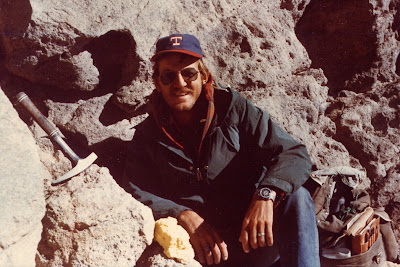
This is a photo of me on the top of Kuh-e-Taftan with a piece of the sulphur visible next to my hand.
Taftan (in Persian: تفتان Taftân) is an eroded stratovolcano in southeastern Iran situated in the Sistan and Baluchestan province. At nearly 4,000 meters (13,000 ft) above sea level, it is the highest mountain in southeastern Iran. The nearest city is Khash. Taftan is a Persian word which means "The Place of Heat".
This is an inactive volcano, however sulphurous gases are emitted from fumaroles at its summit. The peak is usually ascended from west side where a well-equipped shelter has been built. There are very strong winds on this mountain. It is difficult to climb it during winters because of extreme cold and the winds which also cause the snow covering the peak to become frozen and very hard. (from Wikipedia)

A stratovolcano, also called a composite volcano, is a tall, conical volcano composed of many layers of hardened lava, tephra, and volcanic ash. These volcanoes are characterized by a steep profile and periodic, explosive eruptions. The lava that flows from them is viscous, and cools and hardens before spreading very far. The source magma of this rock is classified as acidic, or high in silica to intermediate (rhyolite, dacite, or andesite). This is in contrast to less viscous basic magma that forms shield volcanoes (such as Mauna Loa in Hawaii), which have a wide base and more gently sloping profile.
Although stratovolcanoes are sometimes called composite volcanoes, volcanologists prefer to use the term stratovolcano to distinguish among volcanoes because all volcanoes of any size have a composite (layered) structure — that is, are built up from sequential outpourings of eruptive materials.
Subscribe to:
Posts (Atom)