Showing posts with label atmosphere. Show all posts

Friday, November 30, 2007

Atmospheric Temperature and Rising CO2 Levels Do Not Correlate In Last Decade

The following short article illustrates the disconnect between atmospheric temperature and CO2 levels. I think everyone agrees that surface temperature measurements are of dubious validity for a variety of reasons. These include but are not limited to 1) calibration of instruments, 2) location of measuring stations, and 3) the urban heat island effect.

The following average atmospheric temperatures are derived from satellite measurements, thus they have a much greater sampling area, with calibrated instruments, are not subject to local variations, and thus these satellite temperature measurements are considered the most accurate measure of global atmospheric temperatures.

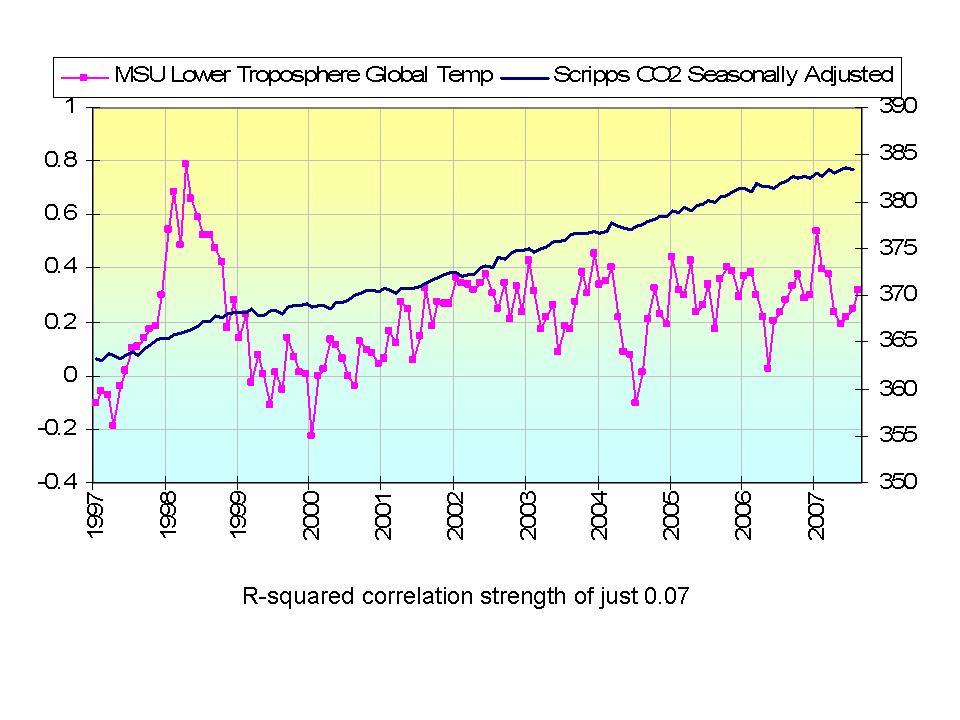
The article goes into more detail, but the key point here, that is so clearly shown in the second graph, is that in spite of steadily increasing carbon dioxide levels, the atmospheric temperature is not rising. This simple observation is completely counter to computer models and predictions of global warming as a result of burning fossil fuels and adding the resultant carbon dioxide to the atmosphere.

If there is no significant recent atmospheric warming, then carbon dioxide emissions must not be a problem. Can anyone question this data, and its interpretation?

And by the way, the source of this article is from an excellent web site titled ICECAP and is located here: http://icecap.us/index.php

They have an impressive list of science advisors and contributors. I highly recommend you examine what they offer.
Peter


Tuesday, November 27, 2007
Global Temperatures are Uncorrelated with Carbon Dioxide Trends This Last Decade
By Joseph D’Aleo, CCM
Temperature peaked in 1998 and have shown no warming for a decade now. Many scientists have been remarking about this trend for several years but no one takes heed, preferring to believe models than actual data. Here is the satellite derived global temperature trend since 1979. Note the cooling globally near the volcanically active periods of the early 1980s and 1990s. Note also the warm spike associated with the super El Nino that seemingly marked the beginning of the end of the warm Pacific trend that began in 1978.

Note the subsequent cooling as a series of 3 La Ninas in 4 years helped cool the earth in the late 1990s. Temperatures rebounded a bit in the early 2000s with a slight rebound in the Pacific warmth, three El Ninos and a volcanic aerosol-free stratosphere, but the trend since 2001 has been flat and at a level considerably below the peak of 1998. This lack of warming has occurred despite the increases in carbon dioxide. Indeed, when comparing this satellite derived temperature trend the last decade with the carbon dioxide increases as seasonally adjusted from Scripps, we find NO CORRELATION (just 0.07 r squared!!!)
See larger image here.
Global warming is over. Man was never responsible.
See full blog here.

Friday, July 6, 2007

Climate Changes (Warming) Have Brought Great CO2 Pulses Up From the Deep Sea (maybe)

This is an interesting article which reveals some of the complexity involved with the relationship between the oceans and the atmosphere, and of course the role of carbon dioxide and global warming. Read carefully and you'll realize how little the scientists really know. They're doing what scientists do; exploring, speculating, trying to understand.

This means more study and more funding, which is fine; but there is just not enough evidence that man is causing global warming to create massive changes is social policy.
Peter

from: http://www.ldeo.columbia.edu/news/2007/05_14_07.htm

News 05/14/07
Contact: Clare Oh 212-854-5479 or coh@ei.columbia.edu

Climate Swings Have Brought Great CO2 Pulses Up From the Deep Sea

Researchers use sophisticated research vessels to extract deep-sea sediment cores from oceans around the world, allowing them to chart past climate change.
A study released on May 11, 2007 provides some of the first solid evidence that warming-induced changes in ocean circulation at the end of the last Ice Age caused vast quantities of ancient carbon dioxide to belch from the deep sea into the atmosphere. Scientists believe the carbon dioxide (CO2) releases helped propel the world into further warming.

The study, done by researchers at the University of Colorado, Kent State University and Columbia University’s Lamont-Doherty Earth Observatory, appears in the May 10 advance online version of the leading journal Science.

Atmospheric CO2, also produced by burning of fossil fuels, is largely responsible for global warming. However, scientists have known for some time that the gas also goes through natural cycles. By far most of the world’s mobile carbon is stored in the oceans — 40 trillion metric tons, or 15 times more than in air, soil and water combined. But how this vast marine reservoir interacts with the atmosphere has been a subject of debate for the last 25 years.

The study indicates what many scientists have long suspected, but could not prove: sometimes the oceans can release massive amounts of CO2 into the air as they overturn.
"The lesson is that abrupt changes in ocean circulation in the past have affected the oceans’ ability to keep carbon dioxide out of the atmosphere," said geologist Thomas Marchitto of the University of Colorado, a co-lead author. "This could help us understand how that ability might be affected by future global warming."

The researchers found the evidence in a core of Pacific Ocean sediment brought up from 705 meters — about 2,300 feet — off the coast of Baja California, Mexico. The core held the remains of bottom-dwelling protozoa called foraminifera, which take up carbon from surrounding water and use it to build their shells.

The isotope carbon 14 — normally used to date organic remains such as wood and bones — can also be used to date the water in which the foraminifera grew. Going back through layers built up over the past 38,000 years, the researchers found the shells contained expected levels of C14 in all but two brief periods, beginning roughly 18,000 years and 13,000 years ago. That meant the protozoa were using older sources of carbon, long isolated from the atmosphere.
The carbon could come from only one place: upwelling of the deep sea, from depths of 3 kilometers (nearly two miles) or more.

The researchers believe the water came not from the Pacific, but from the faraway Antarctic Ocean — the only part of the world where great upwelling can occur, due to the bottom topography and wind patterns. Most of the rising C02 probably poured out into the air in southern latitudes, but some carbon-rich water traveled on currents at intermediate depths to the north, where the foraminifera recorded its C14 signature. The upwelling and release of this carbon dioxide matches well with rapid warming and rises in atmospheric CO2 shown in glacial ice cores from Antarctica and other far-flung records.

The researchers believe that largely as a result of these episodes, CO2 in the atmosphere went from 190 parts per million (ppm) during glacial times to about 270 ppm, and remained at that level until recently. A similar but much more rapid rise, to 380 ppm, has taken place since the Industrial Revolution — most of it in the last few decades. Both rises almost certainly stoked global warming.

Exactly what caused the upwelling is not clear, but many scientists believe the world was already undergoing a natural warming cycle, possibly due to a slight periodic change in earth’s orbit. This suddenly ended the last Ice Age, in turn changing ocean currents and wind patterns. The hypothesis favored by paper’s authors is that sudden disintegration of northern ice sheets during this initial warming slowed or halted deep Atlantic Ocean circulation. This in turn warmed the Antarctic, causing massive retreats of sea ice and allowing deep Antarctic waters to surface.

Thus, it is possible that the signal detected in the Pacific ultimately originated on the other side of the world. "Once the CO2 started rising, it probably helped the warming process along — but exactly how much, we can’t say," said Robert Anderson, a Lamont-Doherty expert in ocean circulation who was not involved in the study. "And there is still huge uncertainty as to how the oceans will respond to current warming."

Anderson says the study should be a wake-up call to the scientific community to expand studies of the oceans’ relationship to climate change. Lamont-Doherty senior researcher Alexander van Geen, a coauthor of the paper, was chief scientist on the cruise that collected the cores, and has coordinated much research on them since.

The other authors are paleoclimatologists Scott Lehman and Jacqueline Flueckiger at the University of Colorado, and geochemist Joseph Ortiz of Kent State University.
The paper, "Marine radiocarbon evidence for the mechanism of deglacial atmospheric CO2 rise," was posted on Science Xpress on May 10, 2007. Background information on current thinking about ocean circulation and climate is contained in the latest report from the Intergovernmental Panel on Climate Change.

The Lamont-Doherty Earth Observatory, a member of The Earth Institute at Columbia University, is one of the world's leading research centers examining the planet from its core to its atmosphere, across every continent and every ocean. From global climate change to earthquakes, volcanoes, environmental hazards and beyond, Observatory scientists provide the basic knowledge of Earth systems needed to inform the future health and habitability of our planet.

Saturday, June 16, 2007

The Atmosphere: Part One: Structure and Temperature


There are distinct temperature regimes in the atmosphere from the troposphere (up to about 10 km though this can vary) to the exosphere (escape region) above the thermosphere. The temperature (T) decreases with height (z) in the tropopause which promotes convection, so the troposphere is generally considered well mixed. The opposite occurs in the stratosphere where the temperature increases with height (it has a positive lapse rate; lapse rate = Delta T/Delta z). Although some mixing does occur in the stratosphere it is a more stable, and stratified layer. It is also considerably drier than the troposphere because the temperatures in the tropopause are far below 0 degrees C. An important component of the stratosphere is the presence of ozone. Ultraviolet light is absorbed in the upper part of the atmosphere and by ozone and this causes the higher temperature at the top of the stratosphere where there is an ozone concentration maximum (this maximum is generally between 30 to 50 km).

from:
http://www.phas.ucalgary.ca/~annlisen/teaching/CHEM421/Chem421-lecture2a.html#Structure%20of%20the

Tuesday, March 20, 2007

Global Cooling? It has happened before

The Earth has obviously gone through countless, remarkable periods of both warming and cooling. What should give us pause for thought is these occurred long before man began burning lots of fossil fuels and adding carbon dioxide to the atmosphere. We're not even really sure warming is even occuring and there are obviously factors at work other than man and our pathetically minor input of carbon dioxide.

From a friend, here is a summary from a presentation on the television History Channel about the affects of what is now known as "The Little Ice Age".


A gem off the History Channel this morning.

Consequences of the
Little Ice Age.
It began in the 1300s, wiped out the Vikings in Greenland,
defeated the Spanish Armada, keeping England English, spread potatoes across
Europe, won our Independence, defeated Napoleon, started our westward migration, and created Frankenstein.
It was believed triggered by an increased incidence of Krakatoa-scale volcanic eruptions: 5 per century as compared to the usual 1 per century. And on top of
this: 5.April 1815 came the explosion of Mt Tambora
on Sumbawa, Indonesia. 36 cubic miles of debris were sent up to 15 miles
into the stratosphere. This is 100x the ash of St Helens.
A dusty fog hung all summer over N. Europe. It snowed. In Hungary the snow was brown. Agricultural resources already devastated by Napolean's march into Russia were ruined by the cold. People starved.
As the "year without summer" began in 1816, Percy Shelley, his 19yr old wife Mary, and their friend Lord Byron, went on vacation to Lake Geneva. But it was too cold and grim to go outside. So the three decided to amuse themselves indoors w/ a
contest to see who could write the scariest story.
Mary won.

The potato was brought to Europe from the new world by early Spanish
explorers. But it was culturally out of whack with traditional staples and
was quickly opposed by the clergy who called potatoes the "devil's crop". People starved when crops failed but potatoes were still avoided.
Then came the 30 Years War. A traditional strategy of warfare in
those days was the burning of crops. This destroyed surface crops like the
grains. But potatoes live underground out of touch of burning, and
freezing. Hence, thanks to the 30 Years War, potatoes
finally became accepted as a staple in Europe.

One consequence of global warming is global cooling, considered the bigger threat to survival since it wipes out food supply. The warming causes the cooling owing to glacial snow melt changing ocean salinity which interrupts temperature conveyor currents that currently keep the northern latitudes warm.
Pentagon commissioned a study of the coming ice age scenario. This is raising concern about threats to world order. It is based upon an actual catastrophic temperature change of 802 yrs ago that created anarchy worldwide and changed history. Temp dropped 9 degrees in one year. Rivers froze, crops failed, people starved, nations were drained of resources. Breakdown of societies resulted.
Skirmishes, civil wars, and invasions broke out over resources and water.
This time around it will be worse.
Pentagon is interested to determine how the destabilization will play out and what role the U.S. will have in maintaining world order during the chaos. Likely the U.S. will be soley responsible and plans need be on the shelf.
China a volatile flashpoint. By the scenario, civil war erupts. Chinese Army threatens to invade Russia for it's gas. There will be virtual full scale civil invasion of the U.S. from Latin America. U.S. Navy heads for Gulf to protect Saudi oil resources.

It is not yet clear whether we are going into hyperwarming or hyper cooling. Arguments still out. Behooves to be more cautious w/ possible human influences on global environment